Nobel Prize in Chemistry 1944, awarded to Otto Hahn “for his discovery of the fission of heavy nuclei.”3
She explained fission. He got the Nobel.
Lise Meitner
Physicist
1878–1968
Lecturing at the Catholic University of America, Washington, D.C., 1946. See the original

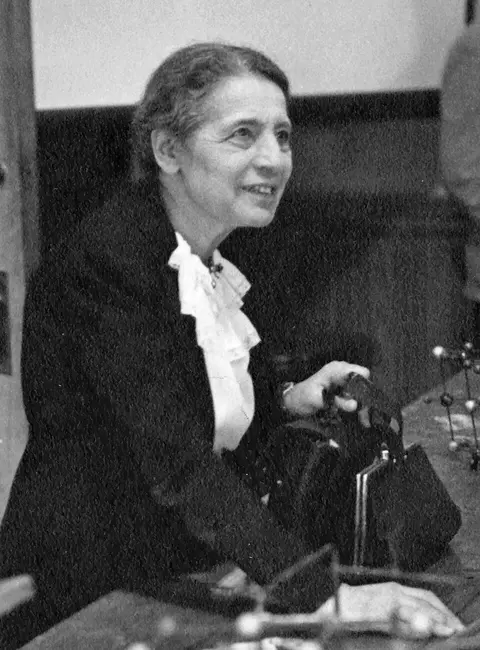
Lise Meitner did the physics that explained nuclear fission. The Nobel Prize for it went to her partner of thirty years, Otto Hahn, alone. Her story is not one of being forgotten by accident: it is the story of a woman pushed out of the record, first by the Nazis and then by the man she had worked beside.
In the Vienna of her childhood, girls were barred from the schools that prepared boys for university. Meitner crammed eight missing school years into two of private lessons, passed the entrance exam at 22, and in 1906 became only the second woman to earn a doctorate in physics at the University of Vienna.1
Berlin, through the back door
In 1907 she moved to Berlin to work with the chemist Otto Hahn. The institute's director would not let women into his building; he was afraid, he said, that they would set their hair on fire. Meitner was put in a former carpentry workshop in the basement, because it had its own entrance. She was forbidden to go upstairs to the labs, and to use a toilet she walked to a restaurant down the street.1
When the two moved to a new institute in 1912, Hahn received the title of professor and a salary of 5,000 marks. Meitner came along as an unpaid "guest". She had worked for five years without pay.1
She rose anyway. From 1917 she ran her own physics section. The two had been hunting for a new element since 1913. While Hahn was away in the army in 1917 and 1918, she did nearly all the work that finally identified it, protactinium, yet Hahn was named came first on the paper. In 1926 she became the first woman in Germany to be appointed a university professor of physics.1
Exile, and the explanation
From 1934, Meitner, Hahn and the chemist Fritz Strassmann worked as a team on the research that would lead to fission; Strassmann later wrote that she had been "the intellectual leader of our team".1 Then, in 1938, Germany annexed Austria, and Meitner, of Jewish descent, lost the protection of her Austrian passport. In July she slipped across the Dutch border with two small suitcases and ten marks in her purse. By August she was in Sweden, stateless and with no money at all.1
That December, Hahn and Strassmann found barium in uranium bombarded with neutrons. They could not explain it, and Hahn wrote to Meitner. She answered the same day that such a breakup was not impossible, and only after her reply did Hahn begin to see what his result meant. At Christmas, walking in the snow with her nephew Otto Robert Frisch, she worked out what had happened: the uranium nucleus had split in two, releasing an enormous amount of energy.1 Their paper in Nature gave the process its name: fission.2
The discovery itself was published under the names of Hahn and Strassmann only.1
The prize
In November 1945, the 1944 Nobel Prize in Chemistry went to Hahn alone, "for his discovery of the fission of heavy nuclei".3 Meitner had been nominated before, and Niels Bohr nominated her again in 1946, 1947 and 1948. Nothing came of it.1 Historians who later opened the committees' files found four reasons for her exclusion: the difficulty of judging a discovery that crossed chemistry and physics, the committees' lack of expertise in theoretical physics, Sweden's isolation during the war, and their failure to see how Nazi persecution had distorted the published record.4
Hahn did not set the record straight. For the rest of his life he described fission as a discovery of chemistry alone, made after Meitner had left; if she had played any part, he suggested, it was in holding it back. Meitner said little in public. Privately, she called it "simply suppressing the past", and added: "I am part of that suppressed past."1
Afterwards
In 1943 Meitner was invited to join the British scientists going to Los Alamos, and refused: she would have nothing to do with a bomb. She kept working in Sweden, retired to Cambridge in 1960, and died there in 1968, a few days before her ninetieth birthday, and a few months after Hahn.1
In 1997, element 109 was named meitnerium in her honour. There is still no Nobel Prize with her name on it though.5
- Born
- 7 November 1878, Vienna
- Died
- 27 October 1968, Cambridge
The birth register of Vienna's Jewish community gives 17 November; every other document, and Meitner herself, used 7 November.
Sources
- 1 Ruth Lewin Sime, Lise Meitner: A Life in Physics (University of California Press, 1996)
- 2 Lise Meitner & Otto Robert Frisch, “Disintegration of Uranium by Neutrons: a New Type of Nuclear Reaction”, Nature 143, 239–240 (1939)
- 3 The Nobel Prize in Chemistry 1944, NobelPrize.org
- 4 Elisabeth Crawford, Ruth Lewin Sime & Mark Walker, “A Nobel Tale of Postwar Injustice”, Physics Today 50(9), 26 (1997)
- 5 IUPAC, “Names and Symbols of Transfermium Elements (IUPAC Recommendations 1997)”, Pure and Applied Chemistry 69(12), 2471–2473 (1997)
Further reading
Image Smithsonian Institution · Public domain· Wikimedia Commons. Printed here as a two-ink halftone.